
CANOPY + WILLOW: From metabolic prediction to clearer design decisions
A new preprint presents the science behind Willow, the first module released in MFI Canopy, and shows how mechanistically grounded metabolism predictions can help discovery teams identify liabilities earlier, interpret them in context, and decide what to do next.


The science behind Willow
Cytochrome P450 (CYP) enzymes metabolize most marketed drugs. Understanding where oxidation is likely to occur can help medicinal chemists anticipate metabolic “hot spots,” investigate potential metabolites, and design compounds with improved metabolic profiles.
Willow brings this capability into Canopy through MFI’s hybrid model combining quantum mechanics with structure-based docking to predict CYP sites of metabolism. Rather than returning a score alone, Willow considers chemical reactivity, three-dimensional accessibility, and how a compound can orient within a CYP active site, giving scientists a basis for interpreting why a site may be metabolized.
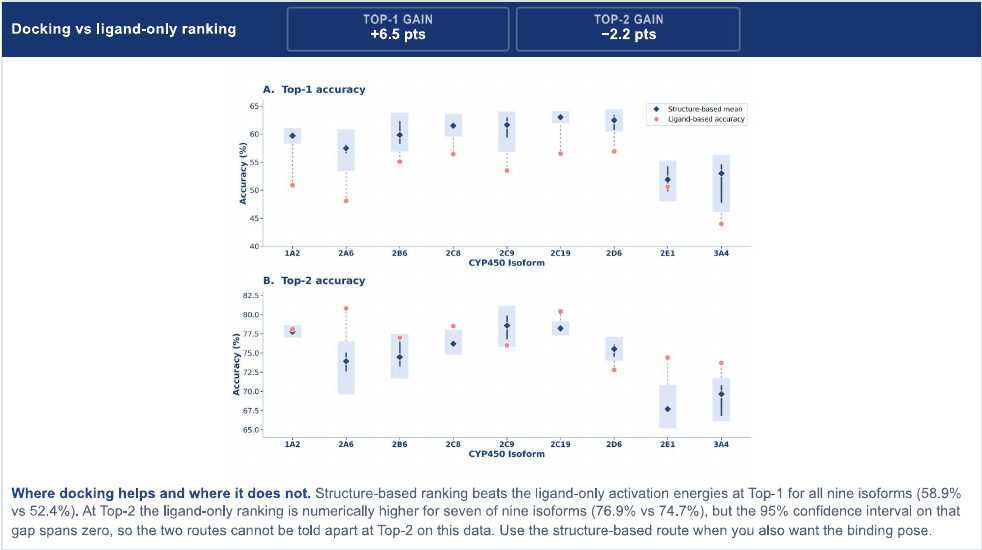
Structure-based and ligand-only ranking across nine CYP isoforms.
What the new study shows
74.7%
Global Top-2 accuracy across nine equally weighted CYP isoforms
9
Major human CYP isoforms evaluated
2,425
Curated molecule–CYP pairs, representing 890 unique compounds
<1 min
Effective runtime per metabolite for eight of nine isoforms
The update introduces a three-dimensional solvent-accessible surface area correction, a more efficient L-BFGS optimizer, and a streamlined docking workflow. In matched testing, the accessibility correction improved L-BFGS Top-1 accuracy by 9.9 percentage points and Top-2 accuracy by 4.4 percentage points.
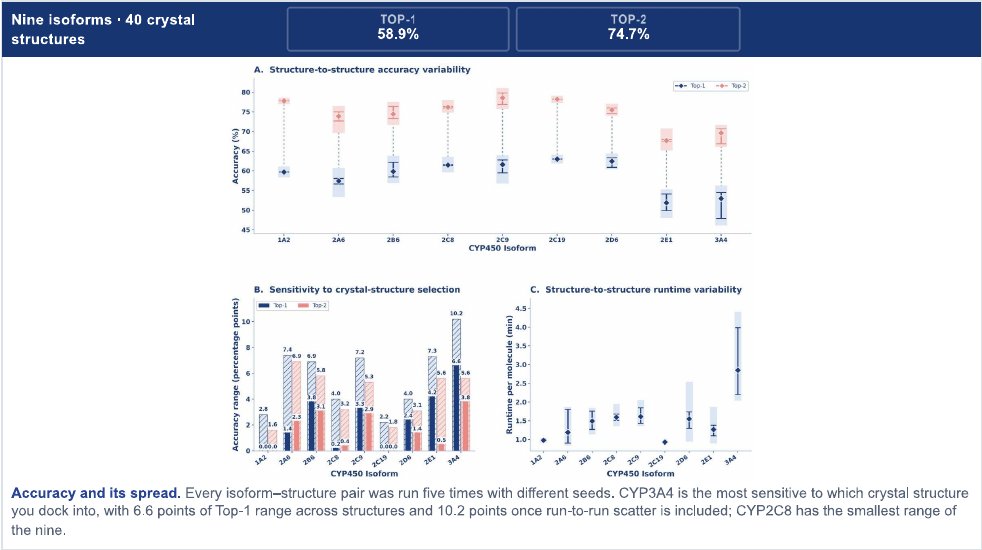
Accuracy across nine CYP isoforms and sensitivity to crystal-structure selection.
The work was also tested on six real-world examples spanning approved drugs and clinical candidates. The method identified experimentally observed metabolic sites for structurally diverse compounds including resmetirom, seladelpar, tranilast, nirmatrelvir, and a challenging macrocyclic voxilaprevir analogue. The case studies show how structure-based results can reveal the interactions behind a prediction and suggest where a design change may alter metabolism.
Docked poses in context
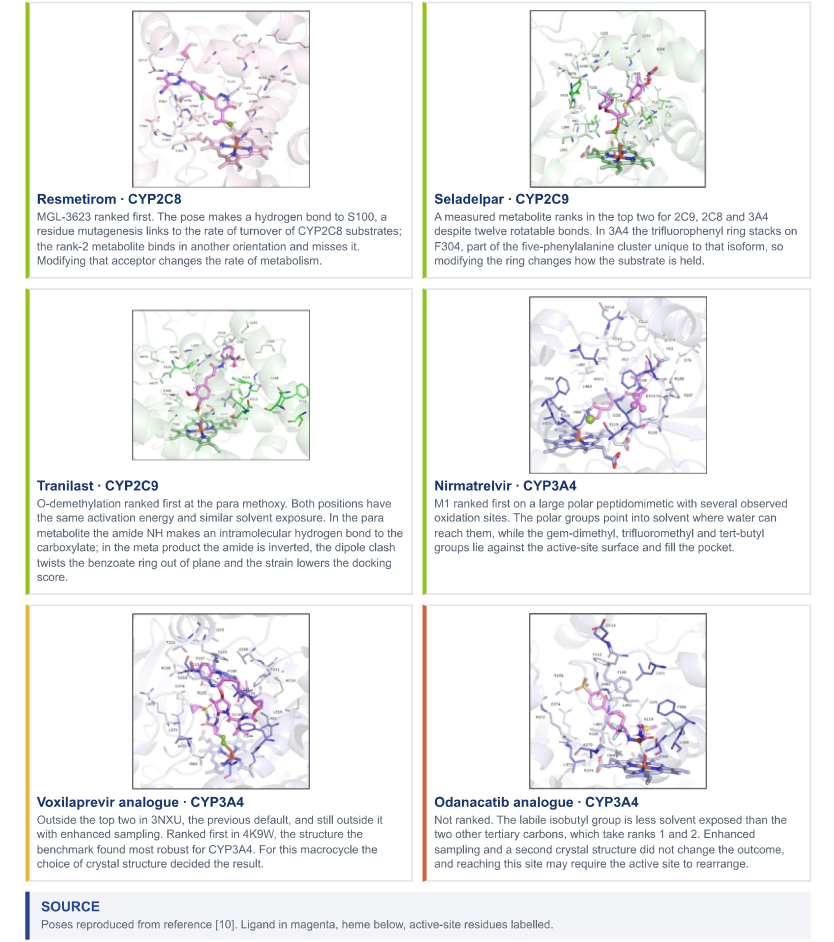
Docked poses for the six case-study compounds, reproduced from the supplied metabolism benchmark PDF (page labelled 13/14). Ligands are shown in magenta, with the heme below and active-site residues labelled. The panels retain the reported ranking results and limitations, including crystal-structure sensitivity for the voxilaprevir analogue and the missed metabolic site in the odanacatib analogue.
From a prediction to a next step
Canopy is MFI’s chemistry-first platform for turning computational insight into clearer small-molecule design decisions. Willow is its first module, bringing metabolism and ADMET insight into the same workflow as chemical structures, molecular properties, and compound comparison.
With Canopy and Willow, teams can:
- Flag potential CYP-mediated liabilities earlier in design
- Explore predicted sites of metabolism across nine CYP isoforms
- Move from ligand-based screening to interpretable, structure-based analysis
- Compare compounds and evaluate metabolism alongside other decision-relevant properties
- Use scientific context to prioritize what to make, test, or investigate next
Built to support scientific judgement- not replace it.
The study also reports where the method falls short, including relatively buried metabolic sites, reactions not yet encoded in the model, and cases that are sensitive to receptor structure. That transparency matters: predictions are most useful when scientists can understand their basis, limitations, and appropriate weight in a program decision.
Built from scientific practice
Willow reflects MFI’s approach to software development: bring together computational chemistry, medicinal chemistry, and software engineering, then test the resulting methods against the questions and trade-offs discovery teams encounter in practice.
The preprint also releases newly curated datasets in MOL2 and JSON formats, covering 4,905 annotated sites of metabolism across nine CYP isoforms. This contribution gives the broader scientific community a more rigorous foundation for benchmarking and developing future metabolism models.
See Willow in Canopy
Bring metabolism predictions into the context of your chemistry, compare design options, and develop a clearer rationale for the next move.
Preprint: “Experimental Data Analysis and Improved Cytochrome P450 Site-of-Metabolism Prediction for Drug Discovery,” posted September 21, 2026. The manuscript has not been peer reviewed, and the data may be preliminary.